Person to person
Genetics, fitness, resting heart rate and lifestyle all shift the baseline. A number that's typical for one person may be high or low for the next — comparing across people is the wrong game.
A good HRV score is one that sits at or above your own normal range — and HRV is unusual in how widely it swings, even for the same person on consecutive nights. Unlike resting heart rate, the raw millisecond figure depends heavily on how each device samples your heartbeat, so the same body can read very differently across apps. That is exactly why a universal "good" number is meaningless: the only honest benchmark is you against your own recent baseline, read as a trend. This guide explains what HRV actually measures, what moves it from night to night, and how to track it without obsessing over a stranger's average.
Lock the $15 founding price.
Recovery you own, on the Apple Watch you already have — pay once, no subscription. Join free now and lock $15 before it rises to $24.99 at launch.
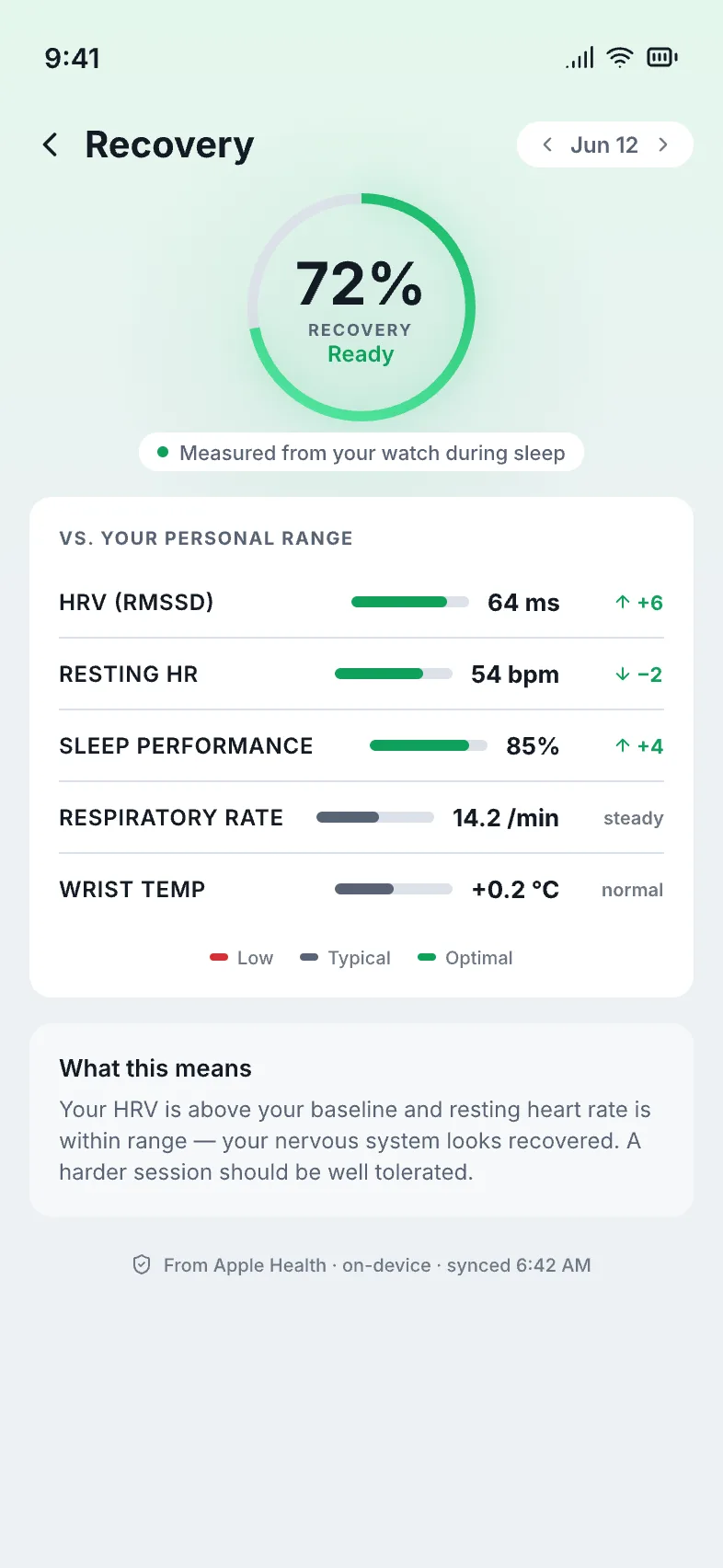
One calm morning recovery score — computed on your own device from the signals your Apple Watch already records.
No. HRV is reported in milliseconds, but that number isn't even a fixed scale: two apps reading the same overnight heartbeat can land on noticeably different figures depending on how each one samples and filters the signal. Stack that on top of genetics, age and fitness, and two perfectly healthy people can sit a long way apart and both be completely normal. So a single fixed "good" value can't survive contact with reality — what's good is whatever is normal-or-better for you, in your own app, against your own history.
Genetics, fitness, resting heart rate and lifestyle all shift the baseline. A number that's typical for one person may be high or low for the next — comparing across people is the wrong game.
HRV tends to drift down gradually as we get older. A "good" target borrowed from a much younger or older group simply doesn't map onto you.
Time of day, body position, and how a device samples your heartbeat all change the figure. A wrist reading overnight isn't the same scale as a chest-strap spot check, so absolute numbers don't travel between apps.
This is why cowe reads HRV against your personal Apple Watch recovery score instead of grading you on a chart built from other people.
You compare today against your own recent normal, and you watch the direction of travel. Three things matter far more than the raw figure: your baseline, the trend, and the context around the reading.
Track HRV for a couple of weeks and a personal "normal band" emerges. Good is sitting inside or above that band; a dip below it is the signal worth noticing — not a fixed threshold from a brochure.
A single low morning means almost nothing — HRV is naturally noisy. A 7-day or rolling average tells you whether you're genuinely recovering or quietly accumulating fatigue.
Late alcohol, a hard session, illness, a stressful day, a warm room or a bad night's sleep all push HRV around. Reading it next to resting heart rate and sleep gives the number meaning.
Early on, before there's enough history, no honest tool should grade you hard. cowe simply tells you when it isn't confident yet, instead of inventing a verdict from thin data.
Plenty — which is exactly why night-to-night swings are normal and a single reading is a weak verdict. The direction below is general and varies by person; treat it as a map of why your number moved, not a promise of how much.
Want to nudge the trend in the right direction? See our practical guide to how to improve HRV, and how to track recovery on Apple Watch day to day.
cowe is a pay-once recovery app for Apple Watch that learns your personal HRV baseline and shows each morning where today sits relative to your own normal. It reads the overnight HRV, resting heart rate and sleep your watch already records, blends them into one calm readiness score, and does it all on-device — no account, no cloud, no separate band.
Instead of a universal target, cowe builds your own normal range from your watch's overnight readings, then reads each day against it.
One number, read in context with resting heart rate and sleep, so a single noisy night doesn't get treated as a crisis.
When it hasn't seen enough of your data yet, cowe says so — rather than dressing up a guess as a score.
New to these signals? See what your Apple Watch already tracks, or read the full pillar on the Apple Watch recovery app — both free, no signup.
A higher resting HRV trend generally points to better recovery, but a higher number isn't automatically better than someone else's. It's only meaningful against your own baseline.
Because it's naturally noisy. Alcohol, late meals, hard training, stress, illness or a restless night all move it — which is why the trend, not one morning, carries the signal.
For most people it gradually declines with age. That's one more reason a fixed "good" number fails — the only fair comparison is you versus you over time.
No. cowe reads the overnight HRV your Apple Watch already records, against your own baseline — pay once, on-device, no account and no separate hardware.
cowe reads your HRV, resting heart rate and sleep into one calm morning score against your personal baseline. Computed on-device, no account, no cloud. Join the waitlist and lock the founding price.