Elevated resting heart rate
A resting heart rate parked above your own normal for several mornings running is the classic, easy-to-read flag that your body is still carrying load. Meaningless as a raw number — telling only against your baseline.
The signs of overtraining are a cluster of recovery signals drifting the wrong way at once — a resting heart rate that sits above your normal, suppressed heart-rate variability, poorer or more broken sleep, low or flat mood, and training that stalls or feels harder than the effort warrants. No single one is a verdict; they all bounce night to night. What matters is several of them sliding together over weeks, and the simplest way to see that is one daily readiness trend on the Apple Watch you already wear. This guide walks the commonly-cited signals and how to catch them early — as wellness, not diagnosis.
Lock the $15 founding price.
Recovery you own, on the Apple Watch you already have — pay once, no subscription. Join free now and lock $15 before it rises to $24.99 at launch.
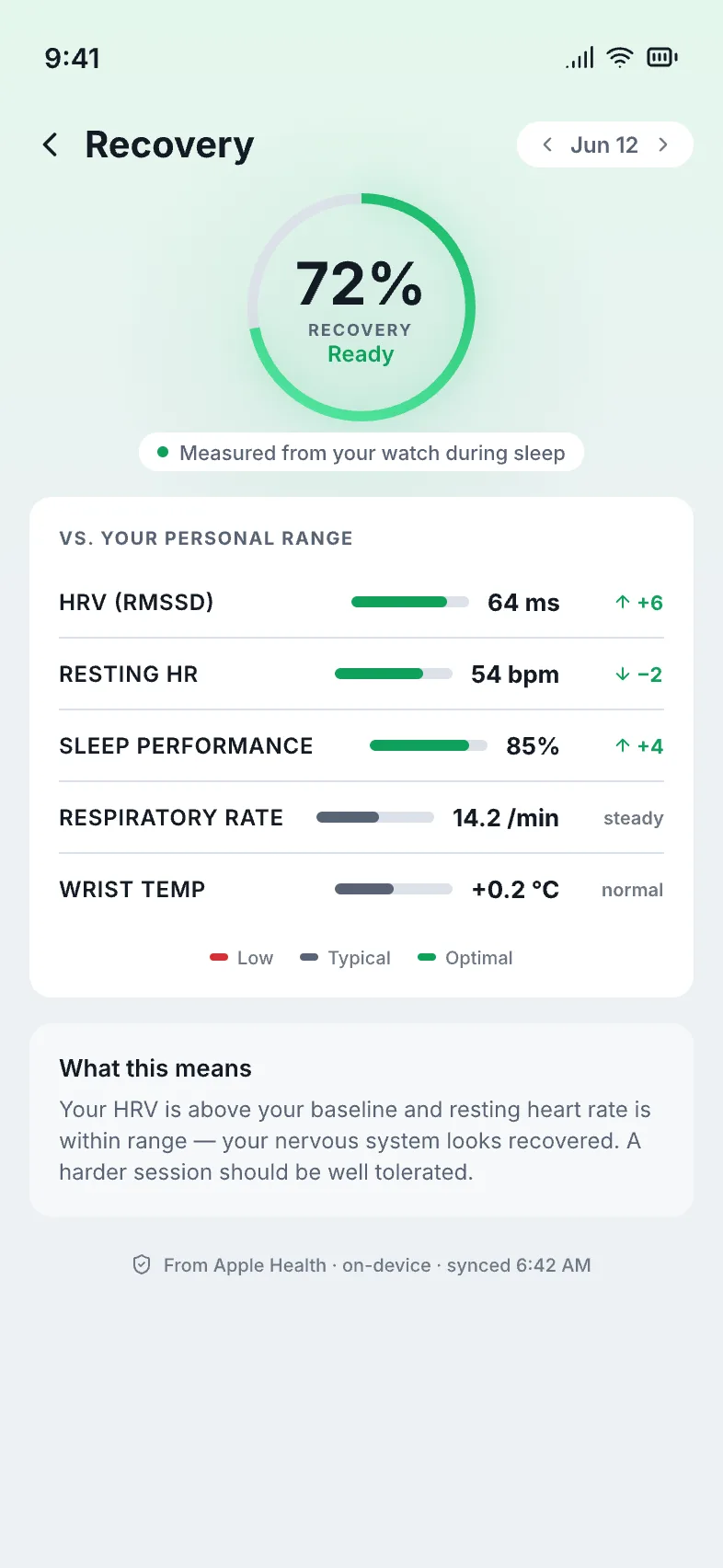
One calm morning recovery score — computed on your own device from the signals your Apple Watch already records.
The earliest signals show up in recovery data before they show up in how you feel. The five most commonly cited are an elevated resting heart rate, suppressed HRV, worse sleep, low mood, and stalled performance. The trap is reading any one of them on a single morning — every one of these wobbles from night to night for reasons that have nothing to do with overtraining, from a late dinner to a stressful day to a glass of wine. The signal lives in the cluster moving together, and in the direction of travel over a couple of weeks rather than yesterday's number. If you are still working out what "normal" even looks like for you, start with what counts as a good HRV for your own range before you read any of these as a warning.
These are the broadly-cited markers — directional, not a checklist to self-diagnose with. Read each one against your own baseline, and treat a cluster of them drifting together, not any single reading, as the thing worth noticing.
A resting heart rate parked above your own normal for several mornings running is the classic, easy-to-read flag that your body is still carrying load. Meaningless as a raw number — telling only against your baseline.
Heart-rate variability that stays low when you expect it to recover is a common marker of a system still braced. It is noisy, so the trend over weeks matters far more than any single low morning.
Trouble falling or staying asleep despite being tired, or shorter and more fragmented nights, often rides alongside heavy training load. Sleep is the foundation the other signals sit on.
Irritability, low motivation or a general flatness is one of the most-reported subjective signals. It is hard to log objectively — but it tends to track the same weeks your recovery trend dips.
Training that plateaus or slides — paces that used to feel easy now feel heavy, sessions you can't finish — despite the same or more effort. Progress quietly stopping is one of the loudest signals once you spot it.
Normal fatigue clears with a rest day or an easy week. The marker that separates a hard block from something deeper is signals that stay suppressed after you back off — a trend that refuses to recover.
None of these is a diagnosis — they are signals to watch. The only verdict that counts is your own trend over weeks. New to the underlying signals? See what your Apple Watch already tracks — a free explainer, no signup.
Because overtraining rarely announces itself on a single day — it creeps in as a slow, simultaneous drift across several signals. Read one morning at a time, you mistake an ordinary bad night for a problem, or you miss a real slide because no single number looks alarming yet. A daily readiness trend folds the signals into one direction of travel, so a fortnight of quietly elevated resting heart rate and quietly suppressed HRV becomes obvious before you feel flattened. Here is the loop that keeps you honest:
Trends matter more than one night. If you train to a plan and want the recovery side dialled in, see recovery tracking built for runners.
You let the watch you already own do the recording, and read one number instead of three charts. cowe is a pay-once recovery app for Apple Watch that folds your overnight HRV, resting heart rate and sleep into a single calm morning readiness score — computed entirely on-device, against your own baseline. Instead of jumping between separate health screens trying to guess whether your resting heart rate is "up", you watch one readiness trend drift or hold. It reads against your normal, not a stranger's, and it tells you plainly when it has not seen enough of your nights to be confident yet — so you are never reacting to a guess. There is no account and nothing syncs to a cloud; it costs $24.99 once (a $15 founding price on the waitlist), with no separate band and no subscription, on the Apple Watch recovery app you already carry. If you want to see those signals turned into a trend you can actually read, join the cowe waitlist and lock the founding price.
It doesn't diagnose it, but it already records the raw signals — overnight HRV, resting heart rate and sleep. The insight is reading them together as one trend. cowe folds them into a single on-device morning score.
A resting heart rate above your own normal for several mornings running is a classic flag. It only means something against your personal baseline, which is exactly how cowe reads it.
Normal fatigue lifts with a rest day or easy week. The concern is signals that stay suppressed despite rest — a trend that refuses to recover. The trend is what makes the difference visible.
No. cowe is a wellness and fitness tool that reads trends from your own data against your own baseline. It does not diagnose, treat or prevent overtraining or any other condition.
One morning readiness number, read against your own baseline and computed on-device. No account, no cloud, no subscription. Join the waitlist and lock the founding price.