What your Apple Watch already tracks (and what it actually means)
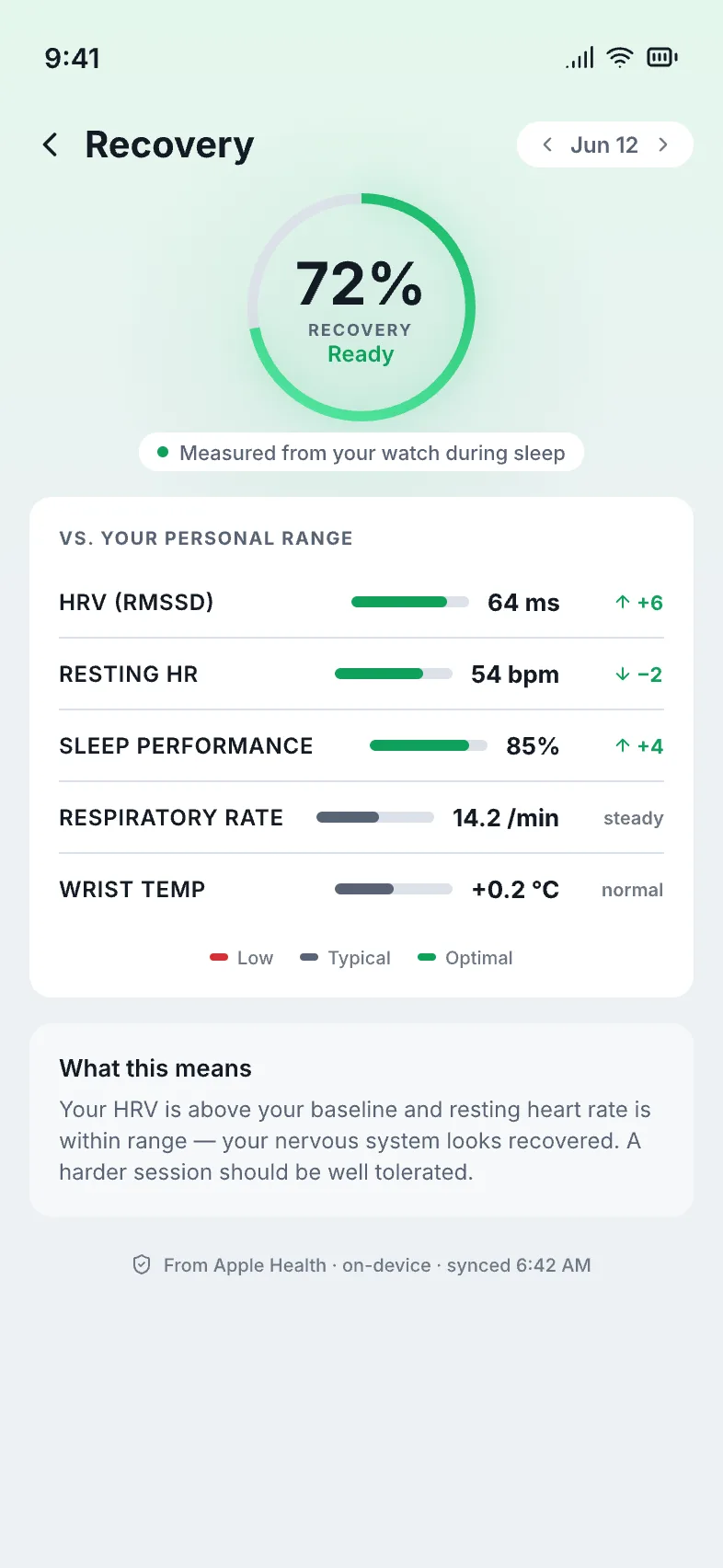
Your watch records HRV, resting heart rate, sleep and wrist temperature
every night — into your phone, on-device. Here's what each one tells you
about whether to push or back off today, how noisy it is, and how long
before a trend is real. No signup. No email.
Heart-rate variability (HRV)
A rough window into how taxed your system was overnight. Very noisy night-to-night — alcohol, late meals, a warm room all move it. Read the 7-day trend vs. your own baseline, never a single morning, never someone else's numbers.
Resting heart rate
Steadier than HRV. When it creeps up over several mornings, that's often an earlier load signal than HRV alone. Best read alongside HRV, not instead of it.
Sleep
Duration and consistency are the foundation everything else sits on. The watch estimates stages; treat the trend as directional, not clinical.
Wrist temperature
A slow-moving baseline signal. Useful as a multi-night trend, meaningless as a one-off reading.
Give any of these ~2–3 weeks before you trust the trend — that's how long it takes to learn your normal.
Lock the $15 founding price.
Recovery you own, on the Apple Watch you already have — pay once, no subscription. Join free now and lock $15 before it rises to $24.99 at launch.
One calm morning recovery score — computed on your own device from the signals your Apple Watch already records.
Want all four turned into one morning number?
One calm morning readiness number — on the watch you already own, computed
on-device, pay once. No account, no cloud, no subscription.