Sleep regularity
Going to bed and waking near the same time is the lever most people can actually move. Consistency, more than any single long night, tends to settle the overnight signal.
Improving HRV is mostly about supporting recovery with everyday habits — consistent sleep, a lighter alcohol load, managed stress, an aerobic base and decent hydration — and then watching your own trend to see what actually helps. Heart-rate variability is deeply personal and noisy night to night, so the win is never a single high reading; it is a steady direction of travel on your baseline. This guide covers the broadly-accepted levers and how to see their effect on the Apple Watch you already wear.
Lock the $15 founding price.
Recovery you own, on the Apple Watch you already have — pay once, no subscription. Join free now and lock $15 before it rises to $24.99 at launch.
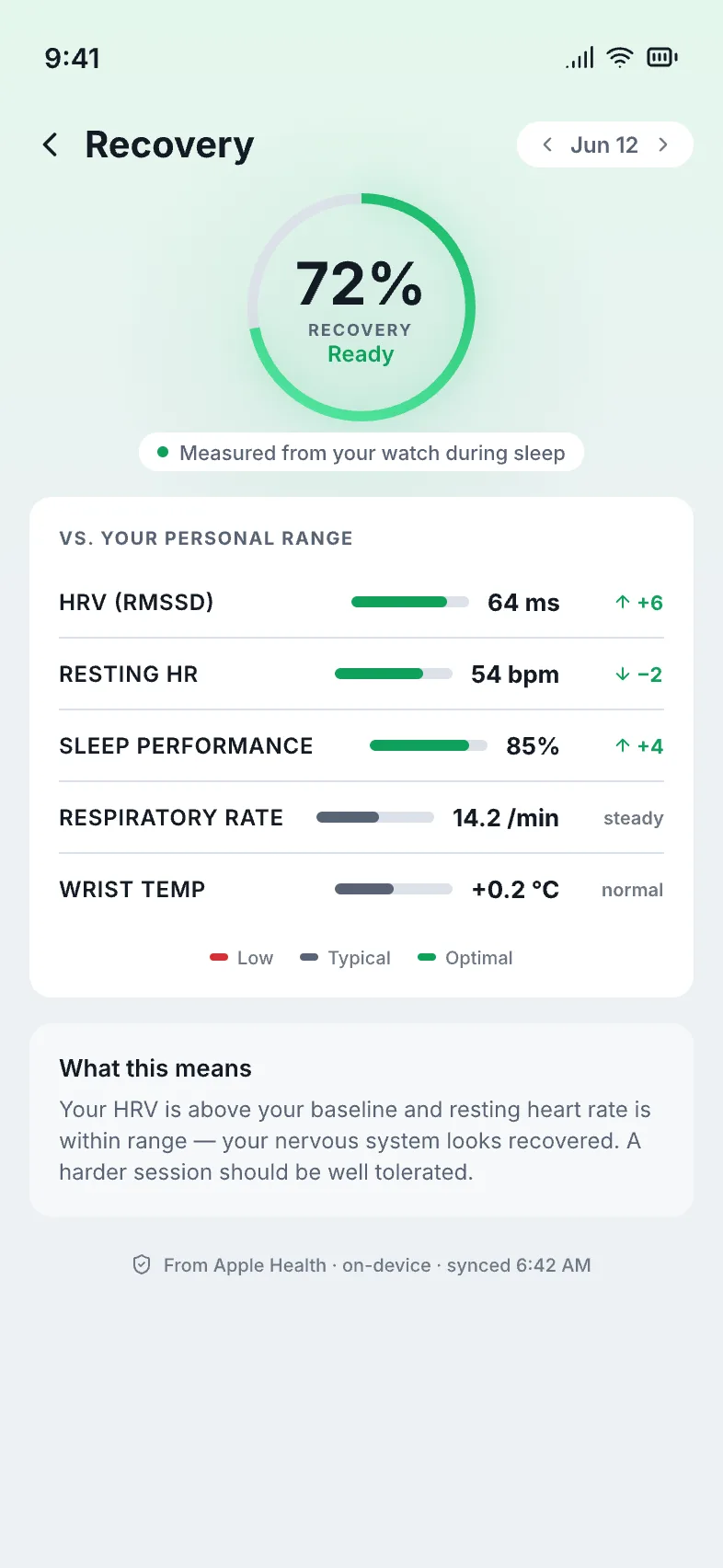
One calm morning recovery score — computed on your own device from the signals your Apple Watch already records.
For most people, yes — but not by chasing a number. HRV reflects how your nervous system is balancing load and recovery, and it responds to the basics rather than to any single trick. The catch is that it is one of the most individual metrics on your wrist: a value that is healthy for one person is ordinary for another, and yours bounces around from night to night. That is why the only honest yardstick is your own trend over weeks, not a target borrowed from a chart. If you are still calibrating what "normal" looks like for you, start with what counts as a good HRV for your own range before you try to move it.
These are the broadly-accepted lifestyle levers — directional, not guaranteed. Treat each as something to test on yourself, then let your own morning trend confirm whether it helps you.
Going to bed and waking near the same time is the lever most people can actually move. Consistency, more than any single long night, tends to settle the overnight signal.
Alcohol is one of the most commonly observed acute drags on overnight recovery. Many people see it the morning after — an easy thing to test against your own nights.
Sustained mental and physical stress keeps the system braced. Wind-down routines, breathing and genuine rest days are the usual ways people give it room to recover.
Easy, low-intensity cardio is the classic long-game lever. It builds slowly, so it is exactly the kind of change you confirm on a multi-week trend rather than tomorrow.
Being well hydrated, especially around training and the evening, supports the overnight readings. Dehydration is a common, fixable reason a morning trend dips.
A heavy meal late at night gives the body more to do while it should be recovering. Earlier, lighter evenings are a common, low-effort experiment to run on yourself.
None of these is a prescription — they are levers to test. The only verdict that counts is what they do to your own data. New to the underlying signals? See what your Apple Watch already tracks — a free explainer, no signup.
Because one morning's HRV is noisy by nature. A late dinner, a hard session, a short night, a stressful day or even where the watch sat on your wrist can all nudge a single reading. Read in isolation, that number can send you chasing the wrong thing. The signal that matters is the direction over weeks. Here is the loop that keeps you honest:
Trends matter more than one night. If you want the mechanics of doing this on Apple hardware, see how to track recovery on Apple Watch step by step.
You read it on your own trend. cowe is a pay-once recovery app for Apple Watch that folds your overnight HRV, resting heart rate and sleep into one calm morning score — computed entirely on-device, against your own baseline. Instead of guessing whether last night's earlier dinner or dry weekend mattered, you watch what your readiness number does over the following weeks. It reads against your normal, not a stranger's, and it tells you plainly when it has not seen enough of your nights to be confident yet — so you are never reacting to a guess. There is no account and nothing syncs to a cloud; every score is computed on the Apple Watch recovery app you already own. If you want the score itself explained, read what the Apple Watch recovery score means, or join the cowe waitlist to turn these levers into a trend you can actually watch.
It varies by person, and single nights are noisy. The signal lives in the multi-week trend — cowe tells you when it is not confident yet rather than show a number it can't stand behind.
It's one of the most commonly observed acute drags on overnight recovery for many people. The honest move is to test it on your own nights and compare your trend.
There's no universal winner, but sleep regularity is the lever most people can move and most likely to show on a personal trend. Support recovery overall, then let your data decide.
No. cowe is a wellness and fitness tool that reads trends from your own data against your own baseline. It does not diagnose, treat or prevent any condition.
One calm morning readiness number, read against your own baseline and computed on-device. No account, no cloud, no subscription. Join the waitlist and lock the founding price.