Fitness
A well-trained endurance heart often beats slower at rest because it pumps more blood per beat. A rate that's low for an athlete could be ordinary for someone else — so comparing across fitness levels misses the point.
A good resting heart rate is one that is normal or low for you given your age and fitness, and that stays steady over time — there is no single universal number that is "good" for everyone. Resting heart rate varies widely from person to person and shifts with how fit you are, how old you are, your genetics and even how you slept last night, so the only honest benchmark is you against yourself, read as a trend rather than a one-morning verdict. This guide explains why that is, what actually moves your resting heart rate, and how to track it without fixating on a stranger's number.
Lock the $15 founding price.
Recovery you own, on the Apple Watch you already have — pay once, no subscription. Join free now and lock $15 before it rises to $24.99 at launch.
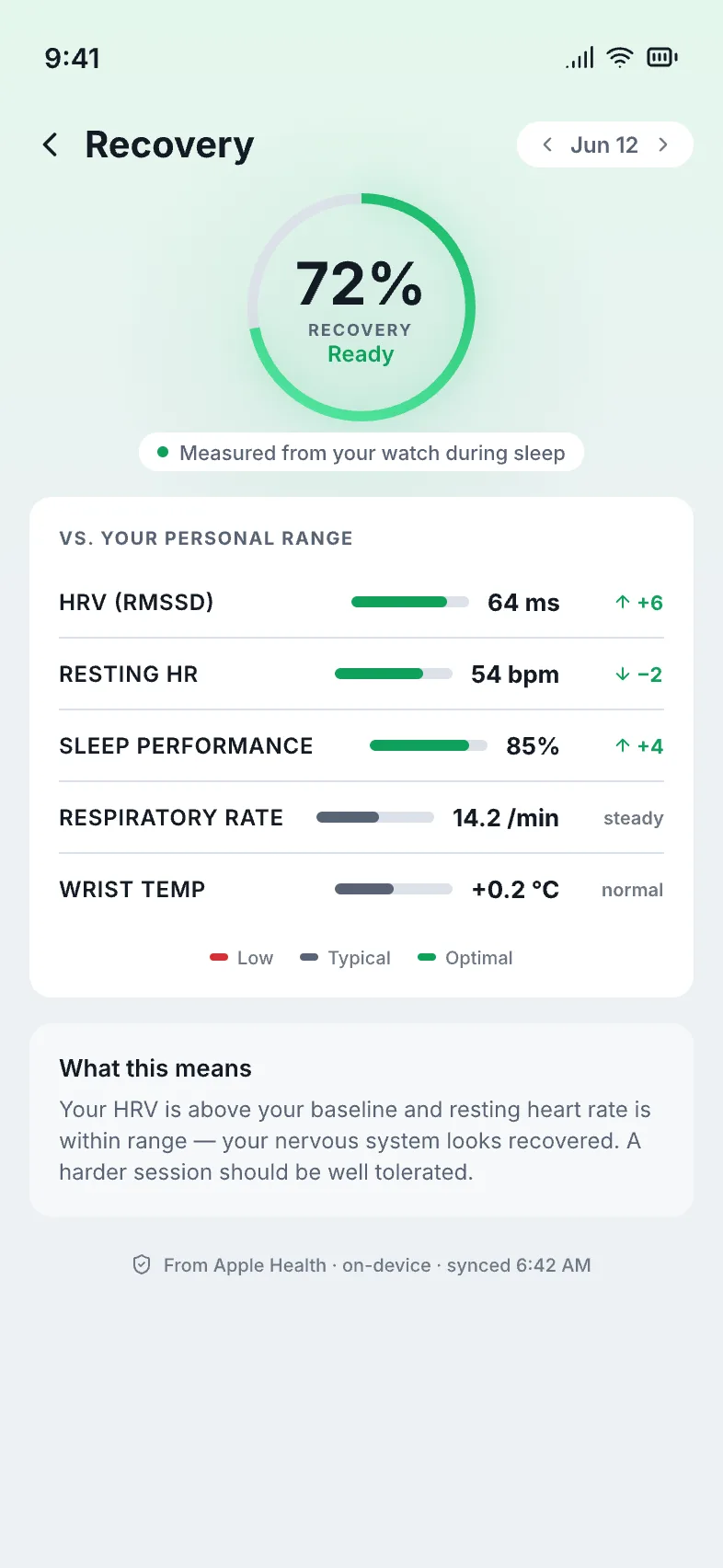
One calm morning recovery score — computed on your own device from the signals your Apple Watch already records.
No. There is no universal "good" resting heart rate, and any page that hands you one fixed number is leaving out the part that matters. Resting heart rate is shaped by so many personal factors that two perfectly healthy people can sit a meaningful distance apart and both be completely normal. What counts as good is whatever is typical, or a little lower, for you — and whether it is holding steady.
A well-trained endurance heart often beats slower at rest because it pumps more blood per beat. A rate that's low for an athlete could be ordinary for someone else — so comparing across fitness levels misses the point.
Resting heart rate tends to shift across the lifespan, and what's typical for a teenager isn't what's typical decades later. A "good" target borrowed from a different age group simply doesn't map onto you.
Genetics, medication, caffeine, body temperature and stress all nudge the figure. Two healthy people of the same age and fitness can still sit apart — which is why your own normal is the only fair yardstick.
This is why cowe reads resting heart rate against your own Apple Watch recovery app baseline instead of grading you on a chart built from other people.
You compare today against your own recent normal, and you watch the direction it's heading. Three things matter far more than the raw figure: your baseline, the trend, and the context around the reading.
Track resting heart rate for a couple of weeks and a personal "normal band" emerges. Good is sitting inside or below that band; a steady climb above it is the signal worth noticing — not a fixed threshold from a brochure.
One high reading means almost nothing — resting heart rate is naturally noisy. A rolling average tells you whether you're genuinely recovered or quietly accumulating fatigue, a brewing cold, or too little sleep.
Late alcohol, a hard session, a stressful day, a warm bedroom, dehydration or a short night all push resting heart rate up. Reading it next to HRV and sleep gives the number meaning.
Early on, before there's enough history, no honest tool should grade you hard. cowe simply tells you when it isn't confident yet, instead of inventing a verdict from thin data.
A resting heart rate sitting clearly outside your usual range, or low and accompanied by symptoms, is worth raising with a doctor — these trends are for wellness, not diagnosis.
Plenty — which is exactly why morning-to-morning swings are normal and a single reading is a weak verdict. The directions below are general and vary by person; treat them as a map of why your number moved, not a promise of how much.
Resting heart rate is one half of the recovery picture. Read it alongside what counts as a good HRV, and see how to track recovery on Apple Watch day to day.
cowe is a pay-once recovery app for Apple Watch that learns your personal resting heart rate baseline and shows each morning where today sits relative to your own normal. It reads the resting heart rate, HRV and sleep your watch already records, blends them into one calm readiness score, and does it all on-device — no account, no cloud, no separate band.
Instead of a universal target, cowe builds your own normal band from your watch's readings, then reads each day against it — so the answer is about you, not an average.
One number, read in context with HRV and sleep, so a single high morning after a late night or a hard session doesn't get treated as a crisis.
When it hasn't seen enough of your data yet, cowe says so — rather than dressing up a guess as a score.
It's the same watch you already wear and the same iPhone in your pocket — a one-time $24.99 ($15 founding on the waitlist), no subscription. See how cowe works on the home page.
Often a lower rate reflects better aerobic fitness, but it isn't automatically better than someone else's — and a very low rate with symptoms is worth a doctor's view. It's only meaningful against your own baseline.
Because it's naturally noisy. Sleep, stress, caffeine, alcohol, hard training, dehydration or illness all move it — which is why the trend, not one morning, carries the signal.
It shifts across the lifespan and with fitness, so a fixed "good" number fails. The only fair comparison is you versus you over weeks and months.
No. cowe reads the resting heart rate your Apple Watch already records, against your own baseline — pay once, on-device, no account and no separate hardware.
cowe reads your resting heart rate, HRV and sleep into one calm morning score against your personal baseline. Computed on-device, no account, no cloud. Join the waitlist and lock the founding price.