The demand side
Your power meter, heart-rate zones and ride time tell you how much you asked of the body yesterday. That's load. It looks backward at what you spent.
Recovery tracking for cyclists is the practice of pairing your training load with a morning readiness score so you time your hard rides instead of guessing. cowe reads the HRV, resting heart rate and sleep your Apple Watch already records overnight into one calm morning number — computed entirely on your device. No chest strap, no separate band, no account, no subscription. You ride hard on the right days and spin easy on the rest.
Lock the $15 founding price.
Recovery you own, on the Apple Watch you already have — pay once, no subscription. Join free now and lock $15 before it rises to $24.99 at launch.
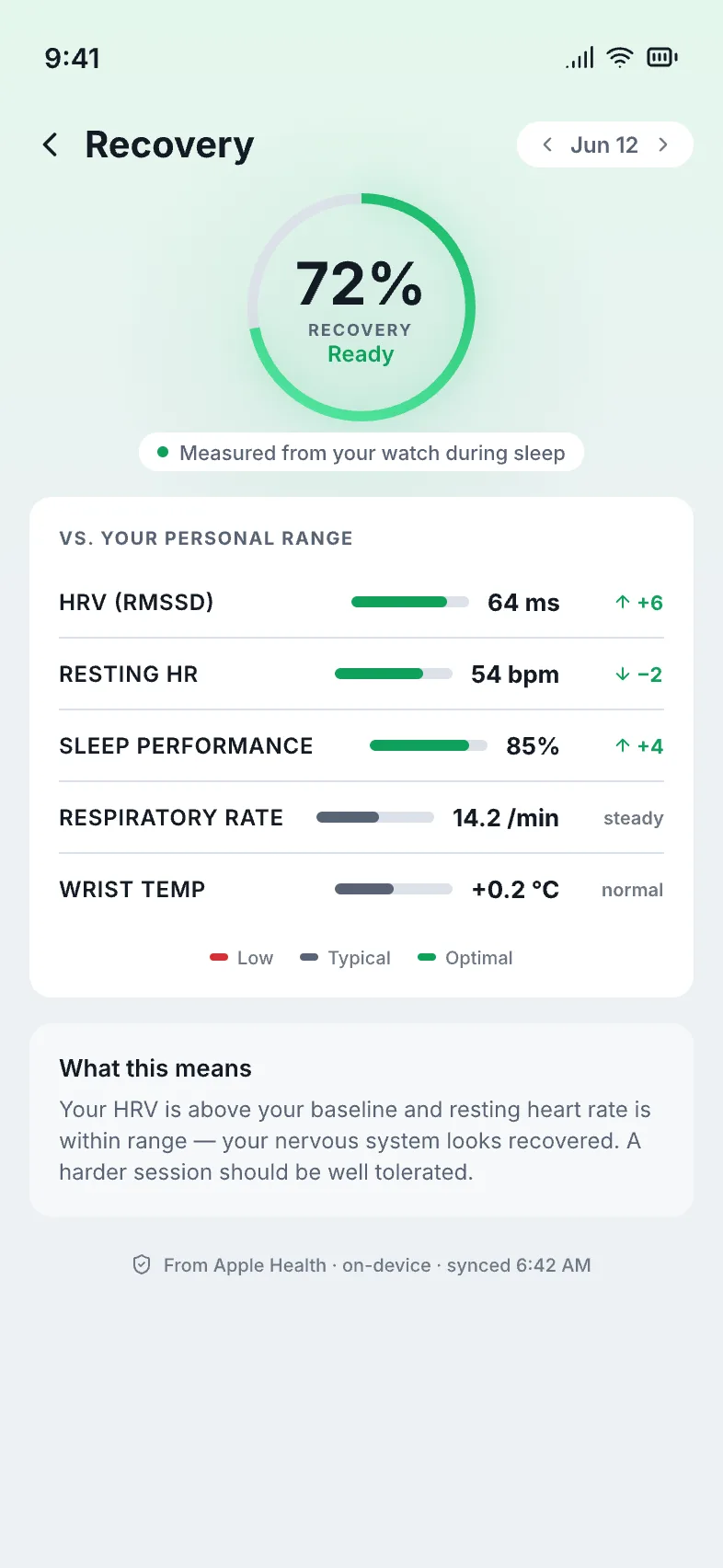
One calm morning recovery score — computed on your own device from the signals your Apple Watch already records.
Because the same hard ride means two different things depending on how recovered you were when you started. Cyclists already measure the demand side obsessively — watts, TSS, kilojoules, hours in zone. What most setups miss is the supply side: whether the body is actually ready to absorb that load today. A 90-minute threshold session on top of a strong morning is productive training. The identical session on top of a depleted morning is how you stack fatigue, blunt your top end and ride yourself into a hole the power file won't show until it's too late.
Your power meter, heart-rate zones and ride time tell you how much you asked of the body yesterday. That's load. It looks backward at what you spent.
Your overnight HRV, resting heart rate and sleep hint at how much you've put back. That's recovery. cowe reads it each morning against your own baseline.
Holding both together is the whole game. Strong readiness plus a planned hard day means commit. Low readiness after a big block means hold the watts and let it settle.
You wake, you glance, you decide — before the kit's on. cowe gives you one morning readiness score read from last night's signals, so you can match the day's ride to how recovered you actually are rather than to how motivated you feel. It works alongside whatever you already use to plan load; it just fills in the half of the equation a power file can't.
New to the load-versus-recovery framing? See how an Apple Watch strain score pairs with recovery — a plain-English explainer, no signup.
cowe reads no new sensor. It uses what your Apple Watch already captures each night and judges it against your normal — the only baseline that matters for a cyclist. A resting heart rate that's fine for one rider is elevated for another; an HRV number is meaningless without knowing what your own settled range looks like. So cowe never compares you to a stranger's average.
A directional read on how taxed your system was after yesterday's ride. Noisy night to night, so cowe weighs the trend against your baseline — never a single morning's number.
Steadier than HRV and familiar to most riders. A creeping resting heart rate across a block is a classic fatigue tell; cowe reads it as part of the same readiness picture.
Duration and consistency are where adaptation actually happens between rides. cowe treats the trend as directional — and says so plainly when it isn't sure yet.
Because as a cyclist you're already carrying enough subscriptions and hardware. The watch on your wrist is recording overnight HRV, resting heart rate and sleep whether or not you do anything with it. cowe simply turns that data into a decision, with nothing extra to charge, strap on or pay monthly.
Cowe is built for every athlete who lives by the data: see the full Apple Watch recovery app, or how it works for recovery tracking for runners and recovery tracking for lifters.
No. Those measure effort during the ride. Recovery is read from overnight HRV, resting heart rate and sleep — which the Apple Watch already captures while you sleep, with nothing extra to wear.
It points, it doesn't dictate. A strong score on a planned hard day is a green light to commit; a low score after a big block is a nudge to keep it easy. It reads the trend against your own baseline.
No. cowe fills the recovery half of the equation. You keep planning load however you like; cowe tells you, each morning, whether your body is ready to absorb the load you had in mind.
No. A one-time $24.99 — no monthly fee, no band. Waitlist members lock the $15 founding price. Everything is computed on your own devices, with no account and no cloud.
No. cowe is a wellness and fitness tool — a readiness signal against your own baseline. It does not diagnose, treat or prevent any condition.
One calm morning readiness score, read from your own signals and computed on-device. Pair it with your training load, ride hard on the right days, and recover on the rest. Join the waitlist and lock the founding price.