Strain — the day's load
How much your body worked: time and intensity at elevated heart rate, active energy, hard efforts. It's the bill you ran up today.
An Apple Watch strain score is a single number that summarises how much daytime load your body took on — built from the heart rate, active energy and exercise your watch already records. On its own it only tells you how hard you went. Read next to a morning recovery score, it tells you whether that effort was a smart investment or a hole you'll pay for tomorrow. cowe reads both, entirely on your device.
Lock the $15 founding price.
Recovery you own, on the Apple Watch you already have — pay once, no subscription. Join free now and lock $15 before it rises to $24.99 at launch.
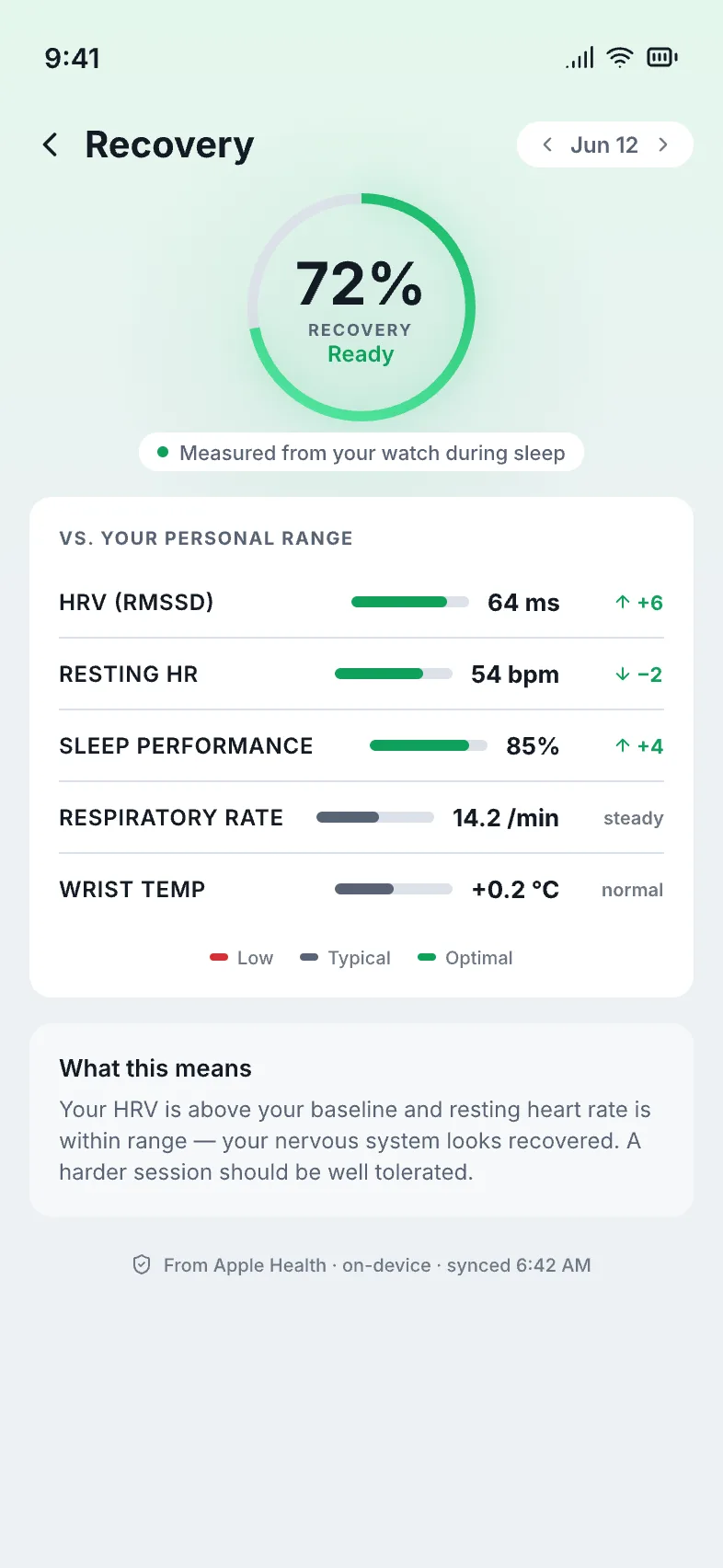
One calm morning recovery score — computed on your own device from the signals your Apple Watch already records.
Not as one built-in number. The Apple Watch captures the raw ingredients of strain all day — heart rate during activity, active energy, exercise minutes — but watchOS presents that as the Activity rings, not a single "strain" or "exertion" figure. Turning that raw load into one score, and putting it beside your recovery, is the job of an app.
If you're mapping the whole picture, start with the pillar: how a recovery app for Apple Watch works.
Strain is the demand side; recovery is the supply side. Strain looks backward at the load you placed on your body. Recovery, read each morning, looks at how ready your body is to absorb more. They measure opposite halves of the same training equation — which is exactly why a number from one is incomplete without the other.
How much your body worked: time and intensity at elevated heart rate, active energy, hard efforts. It's the bill you ran up today.
How ready you are now, read from overnight HRV, resting heart rate and sleep against your own baseline. It's the balance you have to spend.
Effort only has meaning relative to readiness. The same hard session is productive on a strong morning and costly on a depleted one.
Because a strain number in isolation can't tell you whether you trained well or just dug yourself deeper. The same effort reads completely differently depending on the morning it landed on:
The morning side of this is its own topic: how an Apple Watch recovery score is calculated, and the closely related readiness score.
cowe leads with one calm morning recovery score and reads your daytime load beside it, so effort always arrives in the context of readiness rather than as a number floating on its own. No new sensor, no separate band — it uses the heart-rate and activity data your Apple Watch already records.
You open cowe to a single recovery number, read against your own baseline — the readiness you have to spend before the day's load even starts.
Your daytime exertion sits next to that recovery, so a hard day reads as either well-earned or worth easing off — never as a bare figure.
Every number is computed on your iPhone and Apple Watch — no cloud, no account. A one-time $24.99 ($15 founding on the waitlist), never a subscription.
cowe is honest about uncertainty: when it hasn't seen enough of your data to trust a reading yet, it tells you, instead of inventing a confident score.
They share inputs but answer different questions. The rings track whether you moved enough today; a strain score summarises how taxing that movement was. cowe reads the same raw load, then frames it against your morning recovery.
No. The optical heart-rate sensor and activity tracking already in your Apple Watch are what a strain reading is built from. There's nothing extra to buy or wear.
Not by itself. High load is only a problem relative to how recovered you were. That's the whole reason cowe shows load beside a morning recovery score rather than alone.
No. cowe is a wellness and fitness tool — readiness and load trends from your own data. It does not diagnose, treat or prevent any condition.
One calm morning score, your daytime load read beside it, all computed on the watch you already own. No account, no cloud, no subscription. Join the waitlist and lock the founding price.