Heart-rate variability
Captured during sleep as a window into how taxed your nervous system was overnight. It swings night to night, so a single reading tells you little — the trend against your own normal is what matters.
Yes — the Apple Watch tracks the inputs to recovery — your overnight heart-rate variability, resting heart rate and sleep — but it stops short of a single recovery score. watchOS 26 added a Sleep Score, Training Load and the Vitals app, yet none of these is one combined recovery verdict that folds HRV, resting heart rate and sleep against your baseline. It hands you the raw signals; it never hands you one number that says "today is a recovery day." That last step is what a recovery app does, and it is exactly the gap cowe fills — on the watch and iPhone you already own.
Lock the $15 founding price.
Recovery you own, on the Apple Watch you already have — pay once, no subscription. Join free now and lock $15 before it rises to $24.99 at launch.
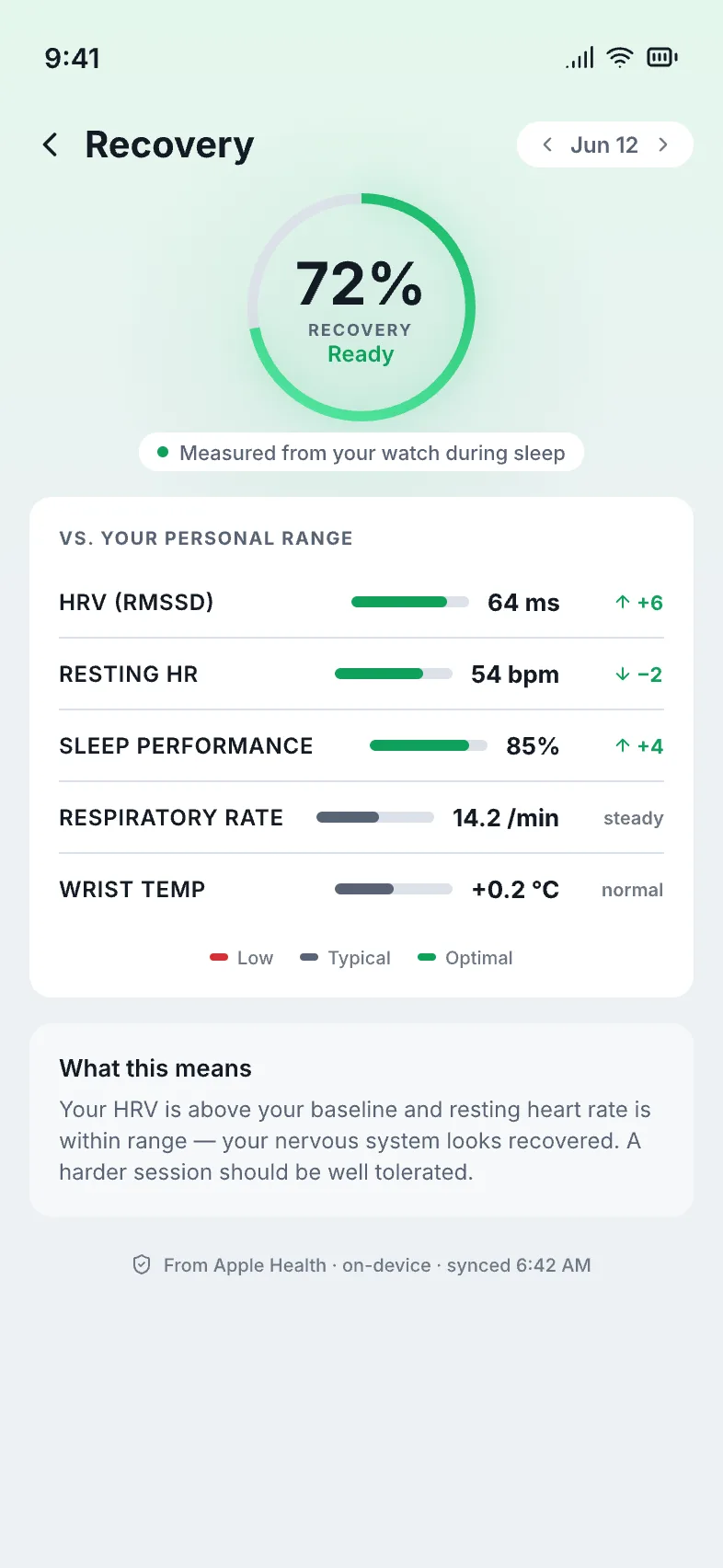
One calm morning recovery score — computed on your own device from the signals your Apple Watch already records.
Quite a lot — and all the right things. While you sleep, the watch is quietly logging the three signals that any recovery model is built on. The data is real; what is missing is the verdict on top of it.
Captured during sleep as a window into how taxed your nervous system was overnight. It swings night to night, so a single reading tells you little — the trend against your own normal is what matters.
Logged through the night and into the morning. Steadier than HRV and easy to read against your personal baseline — a creeping rise often shows up before you consciously feel run down.
Duration and stages, recorded automatically if you wear the watch to bed. Consistent, adequate sleep is the foundation the other two signals lean on.
Want the step-by-step? See how to track recovery on Apple Watch — a free explainer, no signup.
Because tracking and scoring are two different jobs, and Apple does the first while deliberately staying out of the second. The Health app shows each metric and a trend chart, but it never says "your recovery is 64."
watchOS 26 added a 0–100 Sleep Score that rates how well you slept — but it grades sleep only, not your wider recovery (per Apple's watchOS 26 release, September 2025; last checked June 2026).
It also added Training Load, which tracks workout strain over 7 and 28 days. That is the effort going in, not the readiness coming out (per Apple's watchOS 26 release, September 2025; last checked June 2026).
The Vitals app flags nights that drift from your baseline — an outlier flag, not a score. HRV and resting heart rate are still logged automatically, each on its own chart (per Apple's watchOS 26 release, September 2025; last checked June 2026).
So watchOS 26 brought you closer — three new readouts — but still no single recovery score that combines HRV, resting heart rate and sleep against your baseline. The watch tracks the inputs and stops there.
Curious about Apple's own metrics? See whether the Apple Watch has a built-in recovery score.
cowe reads the HRV, resting heart rate and sleep your Apple Watch already recorded and resolves them into one morning readiness number — measured against your own baseline, not a stranger's average, and computed entirely on your iPhone.
Open the app and see a single readiness score instead of three charts. The interpretation is done for you, so a glance tells you whether to push or to ease off.
cowe learns what is normal for you over time and reads each morning relative to that, so the score reflects your trend rather than a one-size-fits-all band.
Every score is computed on your iPhone and Apple Watch. No cloud, no account, no analytics — and pay once, $24.99, with no subscription. Your data stays yours.
Going deeper? Read the full guide to the best Apple Watch recovery app.
It tracks the inputs — overnight HRV, resting heart rate and sleep — but does not combine them into one recovery verdict. You see the metrics; the single score is left to an app like cowe.
Not as one score. watchOS 26 added a Sleep Score (sleep only), Training Load (workout strain) and Vitals baseline flags — per Apple's watchOS 26 release, September 2025; last checked June 2026 — but still no single number folding HRV, resting heart rate and sleep against your baseline. cowe computes that one score on-device.
No. Your Apple Watch already captures the core signals. You need software that scores them, not new hardware. cowe runs on the watch and iPhone you own.
Nowhere off your devices. cowe reads the Health app on-device and computes your score there — no cloud, no account, no tracking.
Once cowe has learned your baseline across several nights. Until then it is honest and tells you when it is not confident yet, rather than showing a number it can't back up.
Your Apple Watch already records the data. cowe turns it into one calm morning readiness score — on-device, no account, no subscription. Join the waitlist and lock the founding price.