Green to push
When your readiness sits at or above your own normal, your system has absorbed the last block. That's the morning to chase the top set, add the plate or hit the planned RPE without second-guessing it.
Recovery tracking for lifters is reading your overnight HRV, resting heart rate and sleep against your own baseline to decide whether your nervous system is recovered enough to push heavy today — or whether it's time to pull the load back and deload. cowe turns those signals your Apple Watch already records into one calm morning readiness score, computed entirely on your device. Pay once, no account, no cloud, no extra strap.
Lock the $15 founding price.
Recovery you own, on the Apple Watch you already have — pay once, no subscription. Join free now and lock $15 before it rises to $24.99 at launch.
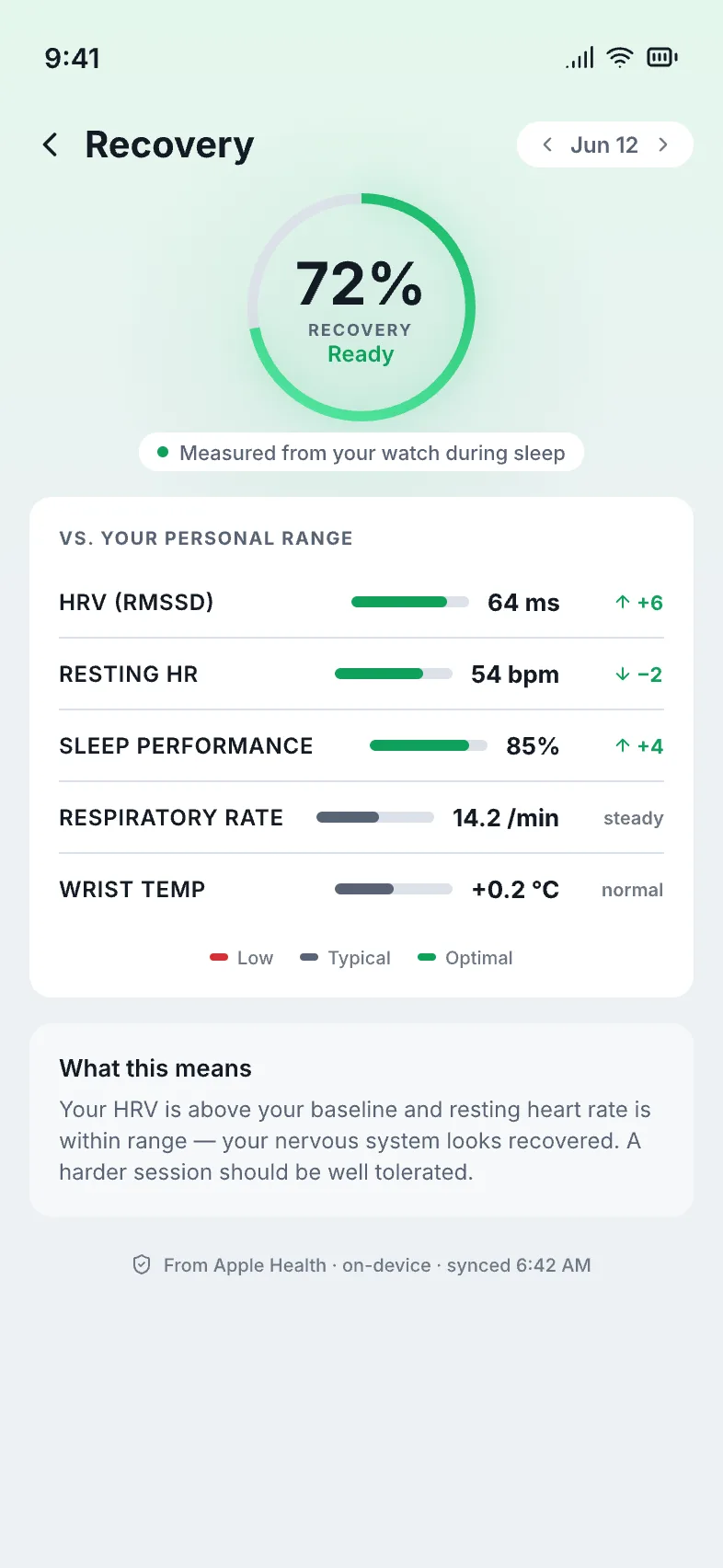
One calm morning recovery score — computed on your own device from the signals your Apple Watch already records.
Read your readiness before you read your program. The barbell doesn't know what your last three nights looked like — your overnight data does. Strength progress lives in the gap between hard work and the recovery that lets you absorb it, and that gap is where most lifters guess. cowe replaces the guess with a trend you can act on.
When your readiness sits at or above your own normal, your system has absorbed the last block. That's the morning to chase the top set, add the plate or hit the planned RPE without second-guessing it.
A readiness sitting right on your baseline says today is a maintenance day. Run the session as written, keep the volume, and don't manufacture a hero workout your recovery hasn't earned.
Several mornings below your baseline is the pattern that usually precedes a stall. Take the deload early, trim intensity, or swap the heavy single for technique work — and let the trend climb back.
Because heavy lifting taxes your nervous system, not only your muscles — and that systemic fatigue accumulates quietly. Sore quads you can feel. A central nervous system that hasn't fully reset between heavy squat days is invisible right up until the bar feels heavier than the number on it.
That's the gap overnight recovery data fills. While you sleep, your body's autonomic balance leaves a fingerprint in your heart-rate variability and resting heart rate. A recovered lifter's signals settle back toward normal; a buried one's stay suppressed. cowe reads that fingerprint against your own baseline — not a population average — so a stranger's HRV number means nothing here. What matters is where you sit relative to your own typical week, and which way the trend is heading.
No new sensor and nothing extra to wear under the bar. cowe reads what your Apple Watch already records overnight and weighs it against your personal trend — then tells you plainly when it isn't confident enough to call it yet.
The clearest read on how taxed your nervous system was after a heavy day. Noisy night to night, so cowe weighs the trend across days against your baseline — never one morning's spike or dip.
Steadier than HRV and a useful counterweight. An RHR creeping above your norm across a training block is a quiet flag that the load is outrunning the recovery.
The raw material for strength adaptation. Duration and consistency are where most missed PRs are really lost — cowe treats the trend as directional and folds it into the morning score.
Want the full picture of what your watch already captures? See how the Apple Watch recovery app works — the pillar guide, no signup.
Because it's built around your own data and your own watch — not a subscription, a second device, or a charging routine you'll forget on the busiest training week. Here's what that means at the rack.
A one-time $24.99 — $15 on the founding waitlist. No monthly fee draining out of your account between training blocks, no membership to cancel when you take an off-season.
No chest strap, no ring, no proprietary band competing for wrist space with your lifting straps. cowe runs on the Apple Watch and iPhone already in your gym bag.
Every score is computed on-device. Your HRV, heart rate and sleep never leave your iPhone — no account, no cloud, no analytics, no tracking of your training.
A new lifter to the app, or a run of broken nights, means thin data. cowe says when it isn't confident yet instead of handing you a false green light before a heavy day.
Your baseline is built from your nights. A score is high or low relative to your own normal week, which is the only comparison that helps you periodise around real fatigue.
You don't want a dashboard before coffee — you want the call. cowe gives you a single readiness figure so the push-or-deload decision takes seconds, not a spreadsheet.
Treat the morning score as a steering input, not an autopilot. The structure of your program still comes from your coach or your plan — readiness just tells you how much room you have on any given day.
Different sport, same idea: see recovery tracking for runners, recovery tracking for cyclists, or the underlying Apple Watch recovery score.
It flags the pattern that usually precedes one — a multi-day drift below your baseline. cowe surfaces the trend; the barbell call stays yours.
No. cowe runs on the Apple Watch and iPhone you already train with. Nothing extra to buy, charge or wear under the bar.
Yes — more so. Heavy strength work taxes your nervous system, and cowe reads recovery signals overnight, not workout minutes. No cardio to log.
A one-time $24.99 — no subscription, ever. Waitlist members lock the founding price of $15 before launch, computed on-device.
No. cowe is a wellness and fitness tool — a readiness signal from your own data. It does not diagnose, treat or prevent any condition.
Nowhere. Every score is computed on your devices. No cloud, no account, no analytics, no tracking of your sessions or sleep.
One calm morning readiness number tells you whether to push heavy or pull back — computed on-device, against your own baseline. No account, no cloud, no subscription. Join the waitlist and lock the founding price.